27 June 2011

Family recipe Monday: hot and sweet

View from the front door, June 24. That's rain + 50 mph wind + hail. 

Impressionistic view of the street completely awash. 


Yeah, about the weather up here.....it's still raining. And hailing. With dangerously high winds. And no one in the family enclaves of West Texas and New Mexico will speak to me about it, because they have triple-digit temperatures, fires everywhere and no signs of a let-up in the drought. No one is going to have any kinds of crops this year, I'm thinking. 


But the farmers' market has started up again, perilously close to the swollen Rapid Creek, and we are able again to get thick-shelled eggs with neon-orange yolks, gorgeous rhubarb stalks, and the world's most decadent triple-berry cinnamon rolls. It will be interesting to see how the selection of produce expands this summer. I have tomato and pepper plants that have not left the kitchen sill yet due to rain and hail outside. Look for recipes calling for three miniature tomatoes and two microscopic peppers later in the summer. 


Tartan Girl sent the following recipe, which turns out to be a winner. Caveat: if you are not a chile head, this may not be for you. Peaches and peppers are a magical combination, blending the heat and the sweet perfectly. Peach salsa is also another dynamite combination. I used mild Hatch green chiles (is there any other kind?) and fresh peaches. The cobbler was better the second day. Somehow it suited the aberrant chilly, wet summer day. 


From The New Mexican Connection: 

 Fiery fruit cobbler

2 cups flour
 3 tsp baking powder
1/2 tsp salt
1/2 cup shortening
1 cup milk
2 tbsp water 
1 lemon, juiced for zest
3 pints of fresh peaches
3 frozen NMC Chiles, chopped
1 cup sweetened condensed milk

Preheat oven to 450ยบ. Mix dry ingredients well, then cut in the shortening until fine crumbs appear. Mix in the milk to form a ball that doesn't stick to the sides of the bowl. On a floured board, knead the dough to about 1/2" thick and cut into 2" rounds using a floured cutter.

Mix water, sugar and lemon juice and set aside until thickened. Sprinkle peaches and chile with syrup and stir. Place in the bottom of a 9x12 glass baking dish. Cover mixture with rounds. Brush dough with sweetened milk and dust with sugar. Bake for 30-45 minutes. Serve warm with ice cream or drizzled sweet milk. 

Make that high-quality vanilla ice cream and you're all set. Happy Monday. Hope everyone's weather improves. 

20 June 2011

Quarries and discoveries

Evidence of early (ca. 2010) Viking occupation of  Sundance, WY

Everyone thinks that museum work is refined, quiet, clean....just as everyone without cats seems to think that they are dainty, finicky, and aloof. Wrong on both counts, at least for this museum (and for all the cats I've been saddled with). Between the ongoing move to the new building and our ongoing field program, I've dealt with more heavy equipment than I knew existed. That's not saying much, since I'm no heavy equipment expert, but it does mean that I know exactly what my hair looks like after a day of wearing a hard hat. (Answer: even more like Beethoven than usual.) (And not in a good way.)

Last week we took a day to go up to our quarry in Wyoming to watch the good guys of the Wyoming DOT move some boulders from the site so that it can be opened for the summer field season. I've had major home appliances that were smaller than these blocks. Thanks to heavy equipment, we're ready to roll.


Classic Morrison Formation school colors, sombre greens and purples

The evil boulders in place. The blue tarp is over the fossils, buried for the year for protection. 


A modern dinosaur clears the way for working on the older ones


The quarry is ready to go, as long as the rain holds off


12 June 2011

Stormy weather

Rapid City, 12 June 2011

Dear Powers That Be,
Look. We have too much water up here. Everything around the Missouri River is in trouble and will be basically under water for the next two months. Rapid Creek is about to go over its banks, and, if I needed quarter-sized hail, I'd have asked you for it already. (BTW, why is hail measured by coin size up here? The Texas measurement system is pea, marble, ping-pong ball, orange, grapefruit, and softball.) We don't need a replay of 1972. 

Meanwhile, the Lubbock folks have had an inch of rain in the past ten months. 

Total. 

Can the entity in charge of the weather settings up there please use a setting somewhere between 1 for Texas and 11 for South Dakota, somewhere in the median range, and leave the dials untouched for a few months?


Thanks. 

31 May 2011

Art, the IWW, and WWI

The Thomas Brooks family, ca. 1890, in Texas. Artemus Clark Brooks stands tallest. Photo courtesy of Linda Schritter. 

I'm still catching up on everything after a month of travel in all directions. Next up is The Next Major Event at the new building, in which we add the emeritus curator's name to the building in front of his friends and family. This is a little overwhelming emotionally for everyone who has worked with him all these years. Just to make sure that everyone in the vicinity finds out how easily I choke up at these events, the Powers That Be have asked me to emcee the presentation. I'm not sure how long I'll make it before I have to claim laryngitis, the sun in my eyes, or whatever other pathetic excuse comes to mind. 

There's also a lot of catch-up work on the genealogy front. As I have had cause to mention before, one should not get into this line of investigation if one is not prepared to deal with all sorts of startling and even abhorrent behaviors on the part of one's ancestors. So far Shirley's family is winning in the reprobate sweepstakes, but that may be only because Ralph's family is a bit more difficult to track. In Ralph's family, we have the die-hard Confederados. In Shirley's, we have at least one known moonshiner, we have Cleophas/Clovis, and now we have Great-Uncle Art. None of this was anything anyone expected. 

Cleophas/Clovis Walker was my grandmother Johnson's uncle on her mother's side. We've discussed his fall from grace with the Feds. His father, John Hinton Walker, was a known moonshiner (which my grandmother denied hotly to the end). On her father's side, however, we find her uncle Artemus Clark Brooks. And his troubles were also with the Feds, but in a strikingly different way. 

Take a look at that gang up at the top. Those are mostly the Brooks children. Twelve of them. Art is standing at the far left. My great-grandfather, Joseph Newton Brooks, is seated at the far right, with his little sister Mandy standing behind him, and his oldest brother William Washington seated next to him. Newt is in his late teens. Art was a couple of years older, the next-to-oldest, born in 1873. 

This is a frontier, homesteading family with precious few resources beyond their own capacity for hard work. That board-lumber house was a lifetime accomplishment. The three oldest boys will take very different paths. William Washington Brooks, the oldest, took his wife and daughter to Mexico--no one seems to know exactly where--and died there. No other details are known. Newt went down to Mexico to bring the widow and daughter back. He homesteaded and made a fairly decent living. 

But Art was different. 

I didn't have any problem finding a reference to Art online, even after all these years. His records were right there with all the others released by the FBI. THAT got my attention. 

Great-Uncle Art was prosecuted as a draft evader in 1921, it turns out. He was not, however, just a typical slacker. 

There are two records for Art that are available. In the first one, we find him charged in Arizona with evading the WWI draft in 1918. Apparently he had moved there to work in the mines, and had incurred the wrath and suspicion of a neighbor who was a grieving father of two soldiers killed in action. The FBI (actually, at the time, just the Bureau of Investigation) followed up on the (anonymous) neighbor's complaint that Art Brooks was a draft evader and  probably plotting the overthrow of the government. 


From the neighbor's complaint: "Art Brooks was very loud in his condemnation of the government and parising [sic] the I. W. W."

Art was arrested on the Forest Reserve near Prescott, Arizona, as an alleged draft evader. His defense was that he was way past draft age: in 1918, he would have been 45. He was 48 when he was arrested. 


P. 2: "A further investigation of subject at post office developed the fact that subject has been receiving what the clerk of the Post Office thot [sic] was radical literature in large packages. On examining his post office box, No. 799, Agent discovered two copies of the APPEAL TO REASON, addressed to Art Brooks, Prescott, Arizona." 


"Subject was unable to make bond and was remanded to the county jail." 

Appeal to Reason was a Socialist Party of America newspaper founded in 1895, when Prairie Populism was a growing trend. In 1921, it was on its last legs and would in fact cease publication the next year. Great-Uncle Art was apparently the family's outspoken Socialist, at a time when Socialism was seen as a major threat by the government. As a supporter of the International Workers of the World, Art would have caught the BI's attention even without the draft evasion charges. Or perhaps he had, but the charges were actionable. 

But it makes no sense, because he was in fact 45, past draft age. He seems to have been guilty of, at worst, being obnoxious. IWW membership was not illegal, and he was not in a place to pose much of a threat to anyone. 

When he appeared for the hearing, the rest of the story came out.


"On cross examination Agent questioned subject with reference to his registering for voting on August 3, 1910, at which time he gave his age as 36 years. He stated that he always stated that he was younger than he really was for the reason that he was unable to secure a position as a miner if he were to disclose his true age." 

The agent seemed to realize at this point that there was not a lot of evidence for draft evasion. The trail stops here. Art seems to have been caught up in a bad combination of his misrepresentations and his unpopular Populist political beliefs, at a time when the country was still recovering from The War to End All Wars. If only that had been true... 

Art died 7 years later in Texas and is buried in the family plot in the Panhandle. He was 55. No descendants are known. Obviously he got out of Arizona and made it back to Texas, but I get the feeling that his life was blighted by his arrest in Arizona. 

If there is a moral to this story, it escapes me. Art was probably never much of a threat to anyone. He was too old to fight in WWI, and he was the only one who suffered for his misrepresentations. But he's not exactly a likable character, either; not much of a poster boy for his beliefs. The Socialist Party of America was collapsing at the time, due in no small part to dissension within its ranks. If Art is a representative of its stance in 1921, it's not hard to see why. 

Content Source: The National Archives Publication Number: M1085 Publication Title: Investigative Case Files of the Bureau of Investigation 1908-1922 Publisher: NARA Short Description: NARA M1085. Before it was called the FBI, the Bureau of Investigation investigated real and perceived threats to the nation and its citizens. Collection Title: Investigative Reports of the Bureau of Investigation 1908-1922 Series: Bureau Section Files, 1909-21 Case Number: 25-8-259-1 Case Title: ALLEGED DRAFT EVADER Suspect Name: ARTEMUS CLARK BROOKS 

24 May 2011

Cleophas and Clovis

I have struggled with this post for a few weeks. It involves a family member, long since gone, whose life was a classic tragedy. No one in our family knew anything about this saga until I started poking around in the family genealogy and breaking down walls that were, in retrospect, put up for a reason. I have no pictures because I can find none. It's a story worth telling, I think, and I am still piecing it together. 

His name at birth was Cleophas Dewitt Walker, and he was the youngest child of John Hinton Walker and Nancy Ellinor Honnoll Walker. That makes him my great-grandmother's baby brother, and my great-grand uncle. He was born in Altus, Oklahoma, in 1892. Times were tough for farming families in the drylands, and by 1917, according to his WWI draft registration record, he was living in Homestead, Florida. In 1922 Cleophas married a girl from the same part of Oklahoma; it appears that he had moved back there. At that point the trail stopped cold. 

I was working on documenting all of my great-grandmother's siblings--all 9 of them--and I could not figure out why someone with such a distinctive first name simply never showed up after that. Finally I called Shirley, who remembered that the family generally called him "Clovis." Easier to spell, I guess, and pronounced almost the same....but not the same name. More on that later. 

Bingo. Clovis D. Walker he was, starting about the time of his marriage and lasting the rest of his life. And it was quite a life for a young man from a dryland farm. 

He had gone to work for the Department of Agriculture. By 1938 he was chairman of the Oklahoma headquarters in Stillwater. Clovis kept moving up in the Agriculture Department, and was transferred to the main office in Washington, DC. He sailed to England in 1948. Apparently, he was the Walker family success story, living in Florida when he was not in DC. I get the strong feeling that he was trying to escape Oklahoma and farming in any way possible. 

And then, in 1952, it all came crashing down. 

From Time magazine, 12 May 1952: 

"When the U.S. Government began stockpiling Egyptian cotton 15 months ago, it looked to a Senate investigating committee as if one Loutfy Mansour, a broker for an Alexandria firm, had an inside track. Out of some $70 million worth bought by the U.S., the committee was told last week, Mansour got a $37 million share.

"From Harold Mesibov, a special investigator for the Department of Agriculture, the committee learned that Mansour had the benefit of some intimate contacts with the man who handled the purchases, Clovis Walker, head of the cotton branch in the Production and Marketing Agency of the Agriculture Department. Walker had sent many messages to Mansour; some signed 'Eula' had been sent by Walker's wife; others which referred to 'the Florida situation' used some kind of code. Walker, who had listed his 1951 income as $17,000, explained this by saying that he had bought $50,000 worth of Florida land after selling off some Oklahoma farmland, and that Mansour was interested in buying an adjoining tract for a 'nest egg.' Walker denied profiting by any of his transactions with Mansour, but admitted: 'Some of the things I've done have been improper.'

"At first, none of this seemed to perturb Secretary of Agriculture Charles Brannan, but his aide reported that Brannan felt Walker had been guilty of only indiscretions. But this week Clovis Walker suddenly quit his job, denying 'any implication of guilt,' but adding that to stay on would be 'embarrassing to the department and detrimental to my health.' "

A high rise and a devastating fall, all on the national stage. In September, according to the New York Times, Clovis was indicted. 

"WASHINGTON, Sept. 15 -- Clovis D. Walker, former Director of the Cotton Branch of the Department of Agriculture's Production and Marketing Administration, and Loutfy Mansour, an Egyptian cotton importer, were indicted today for conspiracy to defraud the United States."

The rest of the story was published six years later by columnist Drew Pearson. From his column released on 29 June 1958:

"Recent revelations regarding Sherman Adams, his gifts, and his influencing of government agencies, make me regret a column I wrote on Feb. 14. 1952. It pertained to another case of gift receiving inside the government. 

"I reported that Clovis Walker, head of the Agriculture Department's cotton branch, had received some gifts from an Egyptian cotton broker named Loutfy Mansour, in the form of Egyptian glassware and silver. I also reported that Walker had given Mansour, in turn, some electrically illuminated pictures which he makes. 

"The column also called attention to the fact that the Egyptian cotton broker had cornered 17,500 bales of cotton just before the Agriculture Department had suddenly decided to buy Egyptian cotton and had cleaned up. But the column did not accuse Walker of giving any inside information to his friend, Mansour.

"Following publication of the column, Walker was promptly removed by scrupulous Charlie Brannan, then Secretary of Agriculture for Truman. Walker had a good record as a civil servant and career official, but in those days more people were removed from office than in the present administration [nb: Eisenhower]. He was also tried in district court for a conflict of interest--which has not happened to any of the conflict-of-interest officials in the Eisenhower administration. 

"In the end, and after a lengthy trial, Walker was acquitted. The trial cost him most of his savings and he is now living in Florida on a meager income...Under the circumstances, I owe an apology to Mr. Walker, which I hereby tender." 

Clovis fell from grace in 1952. He died in Homestead, Florida in 1977, at the age of 85. I cannot find an obituary or a grave for him. Eula remarried after his death and returned to Oklahoma when she was widowed for a second time; she is buried in the same cemetery in Altus where Clovis's parents and some of his siblings are. She died in 1996 at the age of 97. Her obituary makes no note of her life in either Florida or DC. It's written as if she never left Oklahoma.

Shirley was in college in 1952 and raising two tiny children in 1958. At no time did her mother or grandmother ever tell her what was going on with her grandmother's youngest brother, the family success story, the Federal official in Washington, the shamed one, the one on trial. Shirley went to Homestead with her grandmother to visit the next-to-youngest Walker brother, Uncle Marcus. Clovis, Cleophas, whoever he was by then, was still living there, but no one went to visit him, and the feeling she got was that he did not want to see family. 

25 years is a long time to live in disgrace. There were no children, and everyone involved is long gone. It is hard to find words for this situation. I wish that I knew more about Cleophas/Clovis, but I also wish that he could have turned to his family for support. Instead, he turned away and never spoke to them. Drew Pearson's apology came far too late. 

He was one person with two names. The names are not the same. 
Cleophas is Greek in origin and means "vision of glory." 
Clovis is Old German and means "renowned fighter."      

I don't know if that means anything about his life or not.      

If anyone knows anything more about him, please let me know.  


23 May 2011

Family recipe Monday: cooking outdoors

Camp grill and stove made from old oven parts and petrified wood, Lemmon, South Dakota.
Definitely (one hopes) one of a kind. I want it.

With summer almost on us (never mind what the calendar says--in museum land, it's Memorial Day to Labor Day), it's time to start thinking about field work and field cooking. We have a lot of potential sites to cover and a number of people to feed.

Our dear friend Pat has made a second (third? fourth? and all concurrent) career as a gifted camp cook for paleontological projects. Her philosophy is that people work, sleep and get along better if they are fed well. That does not mean two weeks of reheated canned chili. She has a fat file of recipes for dishes that can be easily expanded to fit the number (and appetites) of people at hand, prepared easily, and adapted to local ingredients and conditions. Hers may be the only field expeditions on which people gain weight. Leftovers have never been a problem.

Here is a classic and one of Pat's standards, with her permission. This is for anyone who doesn't believe that camp cooking can be both easy and good.

Pat's green chile chicken/vegetable stew for a crowd

Saute in olive oil *(about 1/4 cup):
1 large onion, sliced
6 cloves garlic, halved

Cook until soft and add:
4 4-oz. cans diced green chile
2 28-oz. cans green enchilada sauce (salsa verde)

Cook briefly to combine and add:
2 T each: ground cumin, red chile powder, green chile powder*, ground coriander, chile-lime powder

Add and cook 15 minutes until soft:
6 medium potatoes (unpeeled, chopped)
2 zucchini, halved and chopped

Add:
1 24-oz packages grilled chicken strips
2 14-oz cans black beans, drained and rinsed
2 14-oz cans corn, drained
2 14-oz cans diced tomatoes (do NOT drain)
2 14-oz cans green beans (drained), ONLY if no zucchini available

Simmer on low for 30 minutes to 1 hour. Serve with tortillas, sour cream, and grated cheese.

*New Mexicans will point out that this is the Christmas combination: red and green chile combined. Reduce the green chile powder to make the stew milder.

Now get out there and find something.

22 May 2011

More catching up


Abandoned church/schoolhouse, South Dakota, at about the level of technology I'd like to have right now.


Have I ever mentioned how much I hate multiple machine failures? I have? Ad nauseam, you say? Well, let me say it again in case the message didn't get through. Threads and Traces is finally back on the air, as it were, after a couple of weeks of transition problems and a computer swooning with the vapors. For a while there it looked as if I needed to fire up the shortwave radio.

I'm assuming that everyone is still here after yesterday's rapture non-event. We are gearing up for an intense couple of weeks, including an overnight-only trip to San Francisco, and ending with the renaming of the new building. Then comes what I hope is the last Summer of Chaos, moving everything into the new building for good, while at the same time installing major storage systems to handle the collections. Then comes the fall semester and teaching the museum exhibits/preparation class. If the world does not end in October, I'll get a breathing space in December.

I can't believe that I moved to the prairies for a slower pace of life. Where did it go?

But I'm proud to say that all that graduate education has paid off. Last Friday I became a legal forklift operator. This was to make OSHA happy about our use of a little electric lift in our field jacket and oversized storage area. I have now taken three driving tests in my life--the original one, the Class B chauffeur's license one so that I could drive a schoolbus for Nature Center outings years ago, and now the forklift one--and the anxiety is just as bad every time. I did, however, pass every time (although I thought they were going to impound the ancient Nature Center bus on the spot as parts kept softly falling to the ground).

As a friend on Facebook pointed out, there are OSHA-approved hard hats in the shape of Stetsons. I think I have to go there.

There are recipes and genealogy tales to catch up on. More soonest. Y'all have a good day, now. Cheers, Sally-Bob.

16 May 2011

Catching up

Giant pheasant sculpture, Enchanted Highway, north of Regent, ND
 
I'm not sure how two weeks went by and a Family Recipe Monday was missed. Twice. In my defense, I'll just say that we had a rare convergence of Synchronized Quadruple Critical Machine Failures (cars, chair and computer) on top of an extraordinarily hectic couple of weeks. I'm working on a longer note about strange and troubling discoveries in the ancestry world (note: do not get into genealogy if you're not prepared to find out that you are related to every deadbeat, cattle rustler and chicken thief in the world).

Family Recipe Monday will resume with a couple of catch-up posts ASAP. In the meantime, please enjoy a few recent roadtrip pictures from northwest South Dakota and southwest North Dakota.


Giant pheasants from the front, Enchanted Highway, ND


Theodore Roosevelt sculpture on the Enchanted Highway. This was about as much enchantment as we could stand. I am sparing you the Tin Family.


Sign, campground, SD. I am really REALLY hoping that this was aimed at hunters...


Sign, Amidon, ND


Sign, Amidon, ND.


Sign, Regent, SD

Highway sign, SD

And you ain't. More to come....


02 May 2011

Family recipe Monday: spring pies

Rustle of spring, 60 mph

It's been two weeks: two really hectic weeks involving 1500 miles of driving from here to Fossil Butte, Wyoming, and back. Since it was late April, we had typical lovely prairie spring weather: snow, wind, sun, more snow, more wind, hail, sun, and still more wind. I looked like Beethoven's surly sister and discovered several new and delightful respiratory allergies....but it was worth it. Details will follow as soon as I get the tumbleweeds combed out.
 
And what a strange and difficult two weeks it has been on the national and international scenes. It seems that we have all had more than our share of losses, disasters and sadness this year. But every year I trace in the family genealogy project has its sad spots. I think that we need to look forward, plant seeds, and move into the sunlight. It's here. The freeze appears to be over and everything is green.

Sturdy warm food does not seem as appealing now as cool light treats. Here are a few great warm-weather pies from the files.


Maud Bowen’s avocado pie


This came from a family in Sedona, Arizona. As a teenager, I visited great-aunt Blanche there in 1971, but needed something to do while Blanche played bridge. All day. Every day. Maud and her family knew all the places to see the area at its best. I would still rather hike than play bridge, any old day. When the family drove out to pick me up, Vada got this unusual and surprisingly good recipe. Only in Arizona...

1 3-oz pkg. lime or lemon-lime Jell-O
¼ tsp salt
1 cup boiling water
1 8-oz can crushed pineapple
1 T lime juice (or more)
1 avocado, peeled and halved
1 3-oz pkg. cream cheese
1 cup whipped cream (optional)
1 9” graham cracker crust

Dissolve Jell-O and salt in boiling water. Drain pineapple. Combine the syrup with lime juice and add cold water to make ¾ cup. Add to gelatin. Chill until very thick. Meanwhile dice half of the avocado. Mash remaining half and blend with cream cheese until creamy. Fold cheese mixture, diced avocado, pineapple, and whipped cream into Jell-O. Fill crust. Chill. If desired, garnish with pineapple or lime slices, or top with whipped cream.
--Maud Bowen

This next one is different in combining a custard preparation with Jell-O. Totally 1950s. I don't recall that there were ever any leftovers, though.

Pineapple and banana pie

Mix ½ pkg. orange and 1 cup pineapple juice. Separately, mix 1 beaten egg and ½ cup sugar. Bring to boil and cool. Mix with Jell-O. Add drained crushed pineapple. Slice bananas into a baked pie shell and cover with the mixture. Chill and top with whipped cream.

I actually looked into the word "chiffon" as applied to pie fillings, since etymologically it refers to silk fabric, and not all of the recipes I have make a smooth filling. All I could find was that "chiffon" shows up in reference to pastries by 1929, though the term for fabrics is several hundred years older. Which is no help. This is a nice icebox pie, though. "Tall can of milk" is 16 ounces or 2 cups of evaporated milk, chilled. I had to work to figure that one out.


Heavenly chiffon pie

1 pkg. strawberry Jell-O
1 #2 can crushed pineapple
1 tall can milk
1 cup sugar

Put pineapple in saucepan, add sugar and cook 3 or 4 minutes after it starts boiling. Remove from fire and add Jell-O. Whip milk which has been in icebox overnight. Beat until consistency of whipped cream. Add custard mix and pour in baked pie shell. Let set in refrigerator.
--Vada Brooks Johnson

Happy Monday, what is left of it. Celebrate spring as if it's the first one ever.

19 April 2011

White Owl and Red Owl


I had to make a couple of genealogy photo stops in the tiny communities of White Owl and Red Owl on Sunday, an area which Gene has not birded much, so we made a day trip out of it. As mentioned, the snow and sleet weren't taking the day off, either. It was an oddly lovely light, though, and the birds were in full spring courting mode. Here are a few of the sights.


Community hall, Alkali

Abandoned house

Another abandoned house.

Church, Red Owl

Barn in the spring chill

Please tell me this is not a church with two outhouses. Please.

Great blue heron, not liking us.

Belle Fourche River valley

Distant long-billed curlew

Bear Butte in the mists

Storm across the prairie

Hawk on nest

Swainson's hawk, surveying the situation

Wild turkeys courting

Ten males, seven females in this flock

18 April 2011

Family recipe Monday: cold and sweet

Bear Butte cloaked by an unexpected snowstorm

You'd think we'd learn, being on the prairie for some time now....but, no, we just had to go out birding and photographing on an April weekend, in spite of the weather predictions that went from a 30% to a 60% chance of "wintry mix." This is not a good mix when you are out on rural roads. But we are adventurous, daring, and not right bright, so out we went. I'll post a full account tomorrow, once I have the sleet out of my hair.

It was a tough week for many people, waiting to find out how the Federal (and, in our case, state) budget cuts would affect them and their communities. I'm happy to report that the museum is alive and well after the budget cuts. We will need to look at how we survive and thrive in a more austere economy, but we will be around to do that. Not all museums or agencies have fared so well, which is sobering indeed.

So we needed a change of scenery, a chance to get away from the budget migraines, some reassurance that life goes on. Well, it does. So does winter weather in the spring. Oddly, I really wanted something cold and sweet when I finally thawed out. Here are some suggestions from the Simple Gifts files that make a nice transition from winter to spring.

Cinnamon ice cream


1 ¼ cups half-and-half
2 ½ cups whipping cream
1 cup less 1 T sugar
1 stick cinnamon
½ tsp ground cinnamon
6 egg yolks

Warm half-and-half, whipping cream, sugar, and both kinds of cinnamon in a non-corroding saucepan. Steep for about 15 minutes, always keeping temperature below boiling. Taste once or twice; flavor will grow even stronger after ice cream is frozen. Whisk egg yolks just enough to break them up and pour in some of the hot mixture, stirring constantly. Return to the pan and cook over low heat, stirring constantly, until the custard coats the spoon. Strain into a container, put cinnamon stick in for stronger flavor, and chill thoroughly. Remove stick and freeze in ice cream maker. Makes a generous quart. Spectacular on apple pie.

Lemon velvet ice cream

1 quart plus 1 1/3 cups whipping cream
1 quart plus 1 1/3 cups milk
4 cups sugar
2 tsp lemon extract
Juice of 8 lemons
1 T grated lemon rind

Mix together and freeze.

Berry sorbet

1 envelope unflavored gelatin
½ cup sugar
1 ½ cups water
2 cups purรฉed raspberries or strawberries
½ cup cranberry juice or black currant liqueur
2 T lemon juice
Whole raspberries or strawberries for garnish

Mix gelatin with sugar and water in a saucepan. Let stand 1 minute. Stir over low heat until gelatin dissolves, about 5 minutes. Cool to room temperature. Stir in berries, juice or liqueur, and lemon juice. Turn mixture into a shallow baking pan. Freeze 3 hours or until barely firm. With an electric mixer or food processor, beat mixture until smooth. Return to pan and freeze until firm, about 2 hours. To serve, thaw at room temperature for 15 minutes or until slightly softened. Spoon into serving dishes. Garnish with whole berries and serve at once. Makes about 8 servings.

Grape juice blanc-mange

Scald 3 cups grape juice in double boiler, adding ¼ cup sugar. Blend ¼ cup cornstarch with ¼ cup cold water and add to juice. Cook 15 minutes, stirring constantly. Add 1 T lemon juice, then cool slightly. Pour into sherbet glasses and chill. While hot, it is very thin, but it stiffens as it cools. It should be very delicate, not overly stiff. Serve with plain cream and powdered sugar.
--Louise Hastings

Happy Monday. It really is a new season out there; get out and celebrate it.

11 April 2011

Family recipe Monday: Pennsylvania Dutch breakfasts

Myrtle Minerva Deppe Shaffner, Gene's grandmother

The recent wave of day-by-day Civil War Sesquicentennial accounts from 1861 news stories keeps reminding me that we could play out the whole conflict in our own house. I have all the Confederate relatives; Gene is a good Pennsylvania Dutch kid with deep German roots (and a Swedish line as well). There seems to be no crossover: he has no Confederates in his genealogical attic, and I can't find anyone on my side in a Union state by the time the Recent Unpleasantness broke out.

What surprises me is how similar some of the old family recipes are between our families. Maybe I shouldn't be surprised--the Honnolls in my family were of German origin, after all--but I would have thought that generations of increasing Southernness (if that's a word) would have caused a bigger recipe drift (if there is such a thing) than it did.

Gene's maternal grandmother Myrtle Deppe Shaffner came from a family of 18 children in the Berwick area of Pennsylvania. They were all farmers in the Susquehanna Valley area, raising crops and dairy cattle and, well, obviously, children. Some of the Deppes married their first cousins, also Deppes, which means that I have double Deppes in the genealogy, and that is one very different-looking family tree. But they were staunch German Methodists, and so were the Honnoll Confederates. I wonder if they couldn't have worked things out over a big Oktoberfest dinner, and skipped the war.

Here are a few recipes from the Shaffner side, guaranteed to please the palate and frighten the heart. The first one should have been run the day before Shrove Tuesday (=Mardi Gras), but this way you get nearly a year to get your heart ready for the delights. All comments are from Gene's mom Dolly, who would have been 76 this year. She collected the recipes from her family for years, and we are scanning them now.

Fastnachts

These are German doughnuts made eaten on Shrove Tuesday, the day before Lent begins. They are best eaten the same day they are made.

NOTE: Mother used to make these wonderful goodies. I would get off the school bus and hurry up the lane through wind and cold rain, usually in March, and when I opened the door I would be greeted by the aroma of sizzling dough. Although I’m not much of a doughnut lover, I enjoyed a few doughnut holes. Yes, they were made on Shrove Tuesday and they were devoured by Dad and my sisters and brother as fast as she could turn them out.

1 pkg. active dry yeast
1 C. scalded milk, cooled to lukewarm
4 eggs
1/4 lb. soft butter
2 1/3 c. flour
1/4 tbsp. sugar
1 qt. oil or melted shortening for frying
*XXX (confectioner’s) sugar for garnish

Soften yeast in milk; add eggs one by one, followed by butter, flour, salt, and sugar. Blend well by hand. Cover with a slightly moist tea towel and put in warm, draft-free place to rise until double in bulk. Punch down and let rise until double in bulk again.

To fry, use an iron Dutch oven or similar kettle. Heat oil to 350* F. Heap a tablespoon with dough & scrape it off the spoon with a table knife into the hot oil. Fry about 6 at a time to golden brown on one side the flip over to brown on other side. Remove with slotted spoon or tongs and drain a bit on brown paper. Roll in bowl of XXX sugar. or if you have a tin shaker, you can sift it on. Put on wax paper to cool.

*We also like cinnamon sugar on them. Just mix a bit of cinnamon with sugar & roll fastnachts in it. If you have a tin shaker, you can sift it on.
--Dolly Hess

German apple pancakes

4 eggs
3/4 c flour
3/4 c milk
½ tsp salt
1/4 c (4tbsp) butter divided
2 med apples sliced
1/4 c sugar
1/4 tsp ground cinnamon

Heat oven to 400*. Place 2 9x1 1/12" round cake pans in oven. Beat eggs, flour, milk, salt in small bowl med speed 1 min. Remove pans. Place 2tbsp butter in each pan and rotate to coat. Arrange half the apple slices in each pan and divide batter between pans. Mix sugar and cinnamon and sprinkle over batter. Bake uncovered until puffed and golden (20-25 min). Serve soon as they fall like souffles. Makes 4 servings.

Flapjacks

1 3/4 c. milk
2 tbsp. sugar
1 tsp. salt
1 pkg. active dry yeast
1/4 c. lukewarm water
3 tbsp. vegetable oil or 1/4 c. soft shortening
3 eggs, room temperature
2 c. sifted flour

Scald milk, add sugar and salt and cool to lukewarm. Meanwhile, sprinkle yeast on warm water & stir to dissolve. Add to cooled milk. Beat in oil, eggs, and flour with rotary beater or mixer on medium speed until batter is smooth. Cover and let rise in warm place until bubbly. Put in refrigerator overnight.

Stir down batter. Dip with a 1/4 cup measure and pour onto hot griddle - grease if necessary. Turn as soon as tops are bubbly. Bake to golden brown on other side. Serve at once.

Happy Monday. Hope your kitchen has wonderful aromas.


09 April 2011

Sagebrush and sage grouse

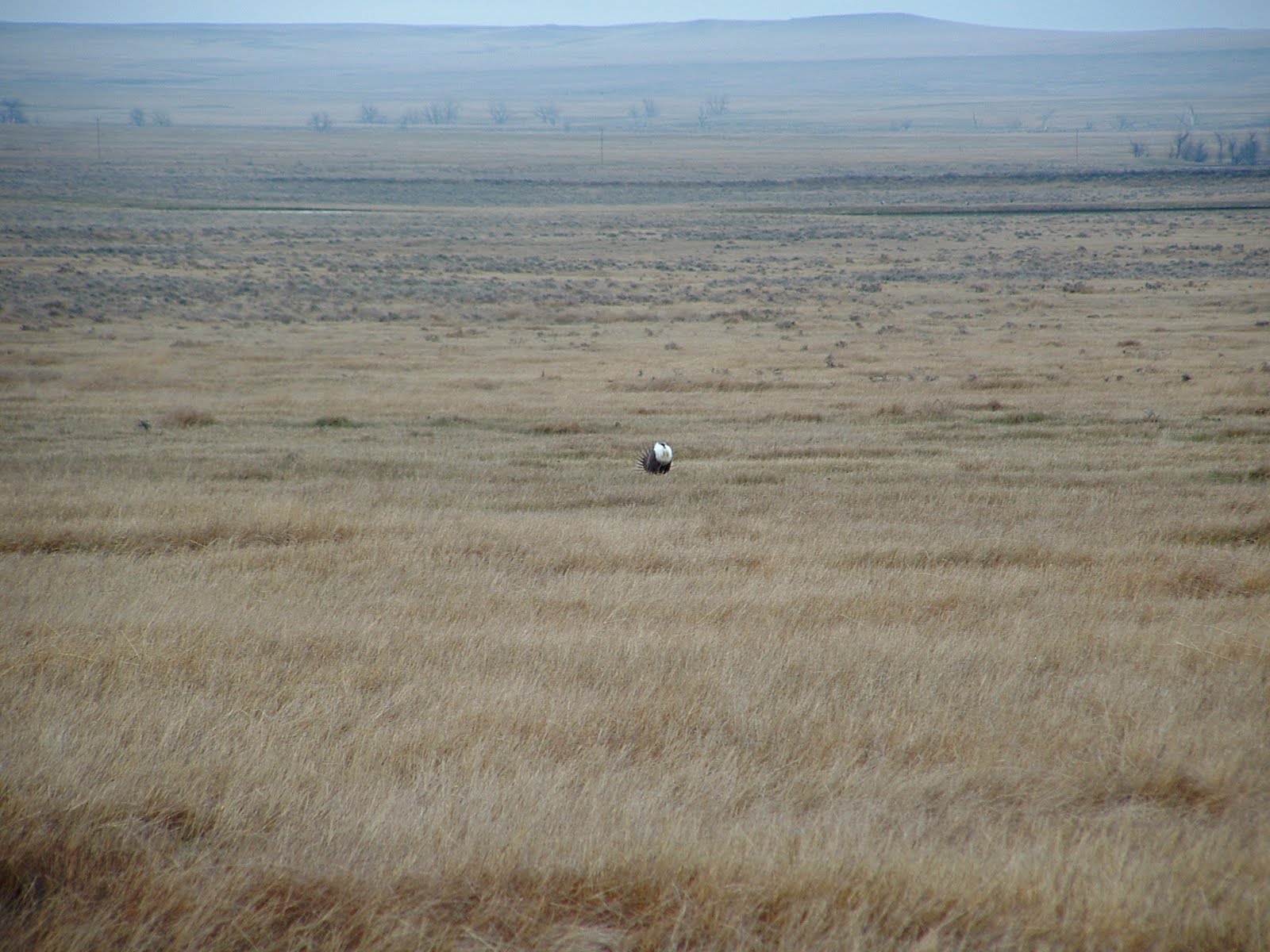
Male sage grouse on lek, displaying. Belle Fourche, South Dakota.

It is spring on the plains and prairies. This means beautiful, soft, mild weather interspersed with scattered ice, fog, high wind, snow, thunderstorms and tornadoes. Two years ago we missed the annual crane trip to Nebraska and just about everything else happening in April because we had major blizzards for 3 out of 4 weekends. This year, the situation is much better, but we don't assume anything.

We went to a site near Wyoming to watch the annual safe grouse lek. Check out the action here. These are shy birds. Normally this trip consists of watching three moving specks on the horizon that look like animated pepper grains and assuring everything that, yes, we do see the grouse, and aren't they lovely? This year, we got the display up close and personal, with a lone male dancing away from the main lek. This guy was dancing and booming for all he was worth, cold or no cold. We could hear him booming. It's love. It's spring.


Turning....

Facing us, air sacs, fully inflated.

Dancer in the sagebrush.

Turning...

Closer to us, great view.


Good view of the inflated air sacs.

Turning in place...

Turning again...

The object of his affections.

Tail fan.

Tail fan.

Moving away...

Tail fan.

Dancing in circles as he slowly moves away.